The Heritage of Wall Paintings
of India
Wall Painting is one of the most delicate forms of art, giving expression to human thoughts and feelings. Explore the magnificent journey from prehistoric cave rock shelters to the classical masterpieces of Ajanta and Ellora.
How did the legacy of Indian wall art begin? Many thousands of years before the dawn of history, when man was only a cave dweller, he painted his rock shelters to satisfy his aesthetic sensitivity. The earliest examples of wall paintings of India are primitive records of wild animals and hunting scenes found in the Kaimur Range of Central India and Vindhya Hills, bearing a remarkable resemblance to Neolithic rock shelter paintings in Spain.
Bridging the Gap: From Harappa to Ajanta
Leaving aside the wealth of materials of the Harappan Culture, the art of India, as a whole, disappears from our sight for many years. However, we can learn a little of this dark epoch by reference to ancient literature. The Vinayapithak, a Buddhist text of circa 3rd – 4th century B.C., refers to pleasure houses containing picture halls adorned with painted figures. Painted halls are also described in the Mahabharata and Ramayana.
These early murals may be assumed to be the prototypes of the carved and painted picture galleries of subsequent periods, standing as the foundation for the most famous wall paintings of India.
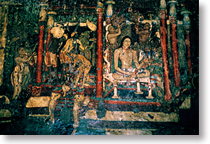 Cave I, Ajanta Caves, Maharashtra
Situated in Maharashtra near Aurangabad, there are 30 caves chiseled out of rock. The subject matter of these paintings is almost exclusively Buddhist, mostly associated with the Jatakas—stories recording the previous births of Lord Buddha.
The contours of Ajanta figures are superb and reveal a keen perception of beauty and form. Among the most remarkable wall paintings of India is ‘The Dying Princess’ in Cave No. XVI. Emotion and pathos are expressed here by the controlled turn of the body and eloquent gestures of the hands.
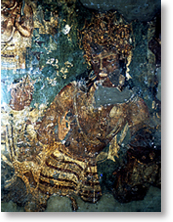 Bodhisattva Padmapani, Cave I
The painting of Bodhisattva Padmapani from Cave I is one of the masterpieces executed in the late 6th century A.D. More than life-size, the figure holds a lotus flower, expressing profound pity and sorrow mixed with hope.
Another memorable event in Cave XVII represents Buddha’s visit to Yashodhara and his son Rahula. The artist drew Buddha on a large scale to indicate spiritual greatness. Yashodhara looks towards Buddha more with a feeling of love than reverence, making this one of the finest portrayals of feminine elegance in the history of wall paintings of India.
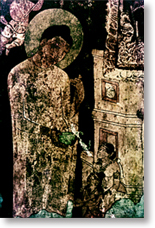 Buddha visiting wife and son, Ajanta (Representative)
The next surviving series are at Ellora, where Hindu, Buddhist, and Jain temples were excavated from living rock. The composition here is measured out in rectangular panels with thick borders—a departure from the borderless classical norm of Ajanta.
Important characteristic features of Ellora painting are the sharp twist of the head, angular bends of the arms, and long drawn open eyes, marking the beginning of the medieval character in the timeline of wall paintings of India.
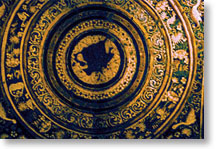 Ceiling Design, Ajanta Caves (Representative)
The most important wall paintings in South India are from Tanjore. The dancing figures from the Rajarajeswara and Brihadeshwara temples are full of movement, vibrating contours, and vitality.
Later, the 16th-century Lepakshi temple near Hindupur illustrated Saivaite and secular themes. These two-dimensional paintings signaled the late medieval period before the art shifted towards miniatures on palm leaves and paper.
The Technique: Fresco-Secco
The technique of early wall paintings of India is detailed in the Vishnudharamotaram (5th/6th century A.D.). Unlike the true fresco method (used exceptionally in Tanjore), most Indian murals used **Tempora or Fresco-Secco**.
The ground was coated with a thin layer of lime plaster, allowed to dry, and then drenched with fresh lime water. Brushes were made from animal hair (goat, camel, mongoose). The artist sketched in red, applied a semi-transparent terraverte glaze, and then filled local colors like red ochre, lapis lazuli, lamp black, and indigo blue.
| Historical Site | Time Period | Primary Characteristics |
|---|---|---|
| Kaimur & Vindhya | Prehistoric / Neolithic | Primitive records of hunting and wild animals |
| Ajanta Caves | 2nd C. B.C. – 7th C. A.D. | Classical contours, Jataka tales, deep emotion |
| Badami Caves | 6th Century A.D. | Soft elastic outlines, sensitive textures |
| Ellora Caves | 8th – 10th Century A.D. | Rectangular panels, angular bends, open eyes |
| Tanjore Temples | 11th Century A.D. | Vibrating contours, vivid dancing figures |
| Lepakshi Temple | 16th Century A.D. | Two-dimensional friezes, profile faces |
Bring Historical Elegance to Your Walls
Inspired by the ancient wall paintings of India? Let Master Artist G.S. Arora create a custom, hand-painted masterpiece for your luxury home, restaurant, or office. No site visit needed!
Frequently Asked Questions